
The HVAC industry is moving toward lower-global-warming-potential refrigerants, and A2L refrigerants are becoming an increasingly important part of residential and light-commercial air conditioning.
For HVAC contractors, understanding what A2L means is essential. The transition affects equipment, installation procedures, service practices, tools, training, and jobsite preparation. This guide explains the fundamentals of A2L refrigerants and what contractors should understand as these systems become more common in the field.
Contractor Focus: A2L refrigerants require technicians to understand refrigerant classification, equipment compatibility, applicable installation requirements, and the tools needed to safely service newer HVAC systems.
Why the HVAC Industry Is Moving Toward A2L Refrigerants
The transition toward lower-GWP refrigerants is part of a broader effort to reduce the environmental impact of hydrofluorocarbon refrigerants used in HVAC and refrigeration equipment.
The American Innovation and Manufacturing Act established a nationwide phasedown of the production and consumption of higher-GWP HFC refrigerants. The transition is being supported through new equipment technologies and the adoption of refrigerants with lower global warming potential.
Many of the refrigerants being adopted for newer HVAC applications fall within the A2L safety classification. For contractors, this means the refrigerant transition is not only about changing refrigerants. It also requires an understanding of how equipment, service procedures, tools, and safety practices are changing with them.
Understanding Refrigerant Classifications
Refrigerant safety classifications are based primarily on two characteristics: toxicity and flammability.
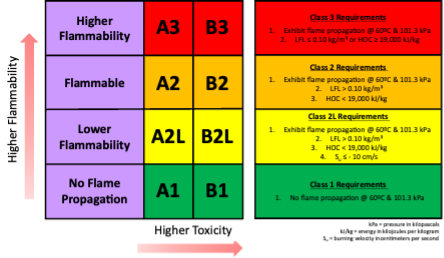
Refrigerant safety classifications organize refrigerants by toxicity and flammability characteristics.
| Classification Element | What It Indicates |
|---|---|
| A | Lower toxicity classification. |
| B | Higher toxicity classification. |
| 1 | Lowest flammability classification under standard test conditions. |
| 2L | Lower-flammability refrigerants with limited flame propagation characteristics. |
| 2 | Higher flammability than Class 2L refrigerants. |
| 3 | Higher-flammability refrigerants. |
The designation A2L therefore describes a refrigerant with lower toxicity and lower flammability characteristics. These refrigerants require different considerations than traditional A1 refrigerants while remaining significantly different from higher-flammability refrigerants such as A3 refrigerants.
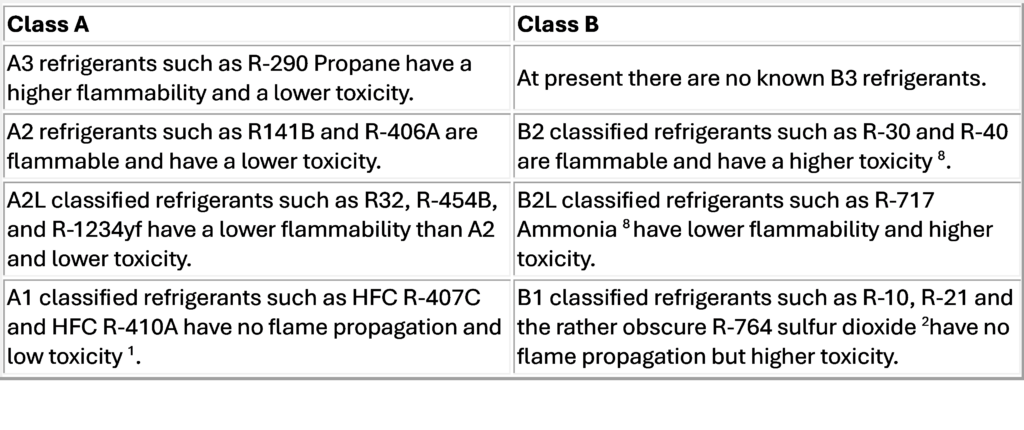
Refrigerant classifications help distinguish differences in toxicity and flammability.
What Mildly Flammable Really Means
The term mildly flammable can sound more concerning than it is without understanding how refrigerant flammability is evaluated.
Several characteristics help determine how easily a refrigerant can ignite and how it behaves if combustion occurs.
A2L refrigerants generally require a higher concentration and more ignition energy than highly flammable refrigerants. Their flame propagation characteristics are also limited. These differences are important when evaluating the actual risk associated with refrigerant use in HVAC equipment.
Lower Flammability Limit
The Lower Flammability Limit, commonly referred to as LFL, describes the concentration of refrigerant in air required before a flammable mixture can form.
A2L refrigerants generally have a substantially higher LFL than higher-flammability refrigerants such as propane. In practical terms, a larger concentration of an A2L refrigerant must accumulate before conditions capable of supporting combustion are created.
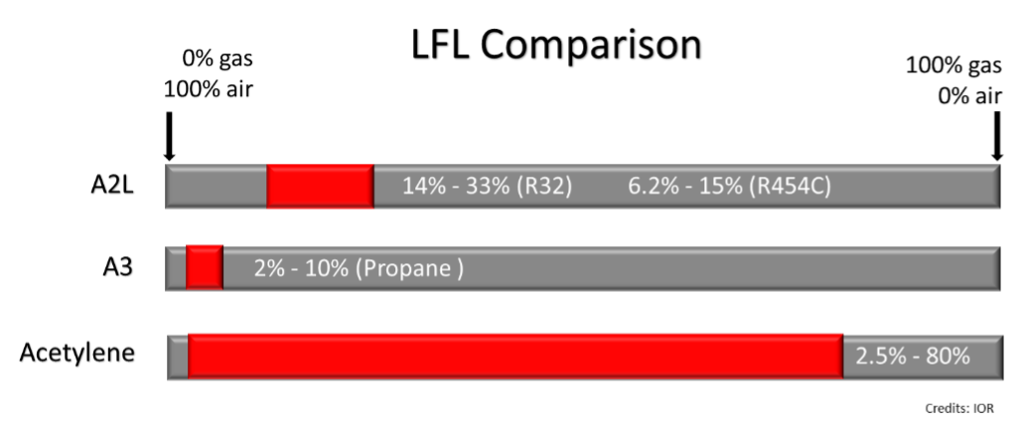
Lower Flammability Limit helps show the concentration required before a flammable refrigerant-air mixture can form.
Minimum Ignition Energy
Minimum Ignition Energy, or MIE, measures the energy needed to ignite a flammable refrigerant-air mixture under suitable conditions.
A2L refrigerants generally require more ignition energy than highly flammable A3 refrigerants. This is another reason why A2L refrigerants are classified separately rather than being grouped with refrigerants such as propane.
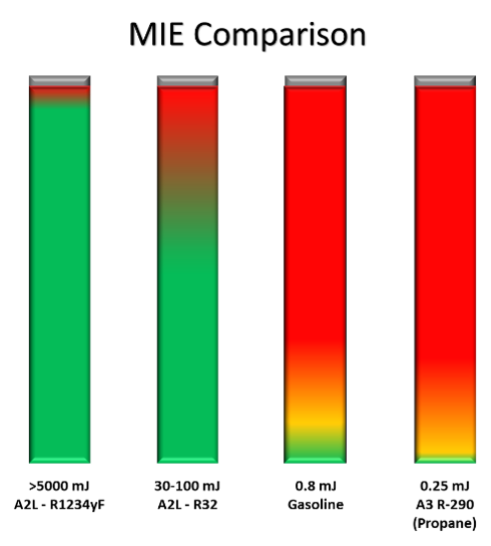
Minimum Ignition Energy measures the energy required to ignite a refrigerant-air mixture under appropriate conditions.
Heat of Combustion
Heat of combustion describes the amount of energy released if a substance burns.
This measurement helps distinguish the behavior of different refrigerant classifications. A2L refrigerants have lower combustion-energy characteristics than highly flammable A3 refrigerants, contributing to the distinction between the two classifications.
A1, A2L and A3 Refrigerants: Understanding the Difference
Contractors do not need to treat every refrigerant with some degree of flammability as if it carries the same characteristics. Refrigerant classifications exist specifically because the level of flammability varies significantly.
| Classification | General Characteristic |
|---|---|
| A1 | Lower toxicity with no flame propagation under standard classification test conditions. |
| A2L | Lower toxicity with lower flammability and limited flame propagation characteristics. |
| A3 | Lower toxicity with substantially higher flammability characteristics. |
What the Transition Means for HVAC Contractors
The growing use of A2L refrigerants affects more than the refrigerant cylinder itself. Contractors should expect changes across several areas of installation and service.
- Equipment: Install only equipment designed and approved for the refrigerant specified by the manufacturer.
- Tools: Confirm that recovery equipment, gauges, leak detectors, vacuum equipment, and related service tools are appropriate for the refrigerant being handled.
- Installation: Follow manufacturer instructions for charge limits, refrigerant piping, clearances, leak mitigation, ventilation, and commissioning.
- Service: Technicians should identify the refrigerant before beginning work and follow procedures appropriate for that system.
- Training: Crews should understand the differences between refrigerant classifications and the procedures required for newer equipment.
- Codes: Contractors should remain familiar with applicable building, mechanical, fire, and local requirements for the installation.
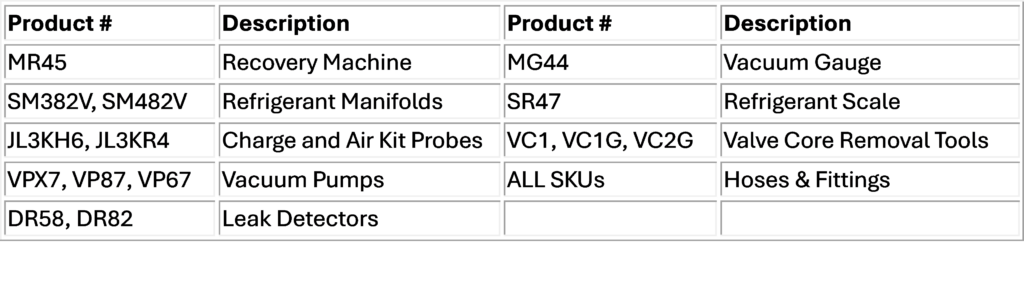
Examples of service tools identified by the manufacturer for use with A2L refrigerants.
Why Training Matters
As A2L equipment becomes more common, technician familiarity will become increasingly important. The goal is not simply to recognize a new refrigerant label but to understand how that refrigerant affects the entire installation and service process.
Training helps technicians become familiar with new equipment designs, refrigerant characteristics, required tools, service procedures, and manufacturer instructions before they encounter those systems in the field.
Contractors who prepare their teams early are better positioned to manage the transition efficiently while maintaining professional installation and service standards.
A2L Contractor Readiness Checklist
Confirm the refrigerant specified for the equipment before installation or service begins.
Check manufacturer installation and service requirements for the specific system.
Make sure required recovery, charging, evacuation, and leak-detection equipment is appropriate for the refrigerant.
Consider equipment location, available space, ventilation, refrigerant charge, and other installation conditions.
Make sure crews understand the systems and refrigerants they are expected to install and service.
Continue reviewing manufacturer guidance, applicable codes, standards, and industry training as the transition progresses.
Preparation Makes the Transition Easier
A2L refrigerants represent an important change for the HVAC industry, but contractors do not need to approach the transition unprepared.
Understanding refrigerant classifications, updating tools where necessary, following manufacturer procedures, reviewing applicable requirements, and investing in technician training can help HVAC companies confidently adapt as newer equipment becomes a larger part of everyday installation and service work.
Why Choose A&R Supply?
A&R Supply is an HVAC and refrigeration wholesale distributor serving contractors and industry professionals throughout South Florida. Our focus is helping professionals get the equipment, parts, tools, and everyday supplies they need to keep work moving.
Get Ready for the Next Generation of HVAC Equipment.
Visit your local A&R Supply or contact our team for HVAC equipment, refrigerants, service tools, replacement parts, installation materials, and support for the changing needs of today's HVAC professional.
Create an account and subscribe to A&R Supply emails for product updates, contractor training opportunities, industry information, and exclusive promotions.